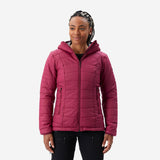
Our team, parents of young skiers, has developed this kids' jacket for learning to ski. Ideal for descending those first slopes warm and dry.
A warm, waterproof jacket with a hood. Perfect for learning to ski in optimum conditions.
- Warmth3
- Warmth150 g/sqm wadding. Fleece lining for maximum warmth and softness.
- WaterproofGOOD:5,000 mm-rated coating. Non-taped seams. Hood.
- BreathabilityBreathable component that helps perspiration wicking.
- Pockets3 pockets including 1 for a ski pass.
- CustomisationLabel on the lining for writing your child's name.
- Thermal insulation will keep your young skiers at the right temperature, neither too hot nor too cold. The garment adapts to the body's physical activity and to the outside environment. Wedze uses wadding for insulation to keep the body warm. Wadding is a synthetic component made from polyester which stores more or less air, depending on the length of the fibres. The thicker the wadding, the more air it contains and the warmer it is.
- The coating is a waterproof substance that's spread on the inner side of the outer jacket fabric. It prevents water from seeping into the garment but allows water vapour produced by the body's physical activity to escape. This way, young children stay dry and are more comfortable.
- No need to get your ski pass out any longer! Your sleeve has a ski pass pocket so you can access the lifts quickly.
- There is a label at the top of the lining on which you can write your child's name to personalise the product. Handy for finding their jacket after ski school, at the crèche or at school.
- To make sure you stay warm and dry, we recommend using the 3-technical-layer rule: Layer 1 or second skin, to stay dry. Layer 2 or an insulating layer, to keep the heat in. Layer 3 or a protective layer, to protect against bad weather.
- Textile dyeing requires a lot of water but also produces waste water from the dye baths. To reduce this environmental impact, we opted for a bulk dyeing process that involves adding the colour pigments when the yarn itself is being produced.