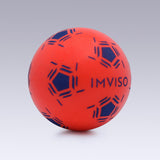
We have designed the FIFA-approved Club Hybrid ball, which pairs comfort with durability, for your training sessions and competitions.
Need a ball for your football club? With the FIFA Basic Club ball, you get 2 layers of foam, making it more comfortable, and invisible seams for durability.
- Robustness2
- RobustnessAchieved a rating of 2.27 on a protocol-based test. Seams on the inside.
- Lasting air retention11% pressure loss in 14 days.
- Stable flightAchieved a rating of 5.96 on a protocol-based test. Classic 32 panels.
- BounceYour ball complies with FIFA requirements in terms of bounce.
- Check out the Play Unlimited subscription: - Worn or punctured balls? Unlimited replacement included - 12-month commitment, then cancel at any time - Monthly or quarterly payments, at your convenience - Minimum 10% discount on the entire Football catalogue - Never more expensive than a traditional purchase, guaranteed - 100% of used balls collected and repurposed in France - Delivery, after-sales service, recycling: an all-in-one service with no surprises Visit our website
- Our design team created this hybrid ball after observing football players in action on the pitch. This ball is a hybrid because its design combines the comfort of a machine-stitched ball with the durability of a hand-sewn one (the seams are on the inside). We've also used a special bladder (2 km of thread is wrapped around it) to ensure lasting inflation and better sphericity.
- We've developed a tool for characterising the durability of our balls. Defects that appear in use are identified and assessed through a series of laboratory tests. These tests enable us to compare the overall strength of our footballs with those available on the market. Our aim: to have the most durable products on the market.
- FIFA Basic approved.
- This ball measures between 63.5 cm and 66.0 cm (size 4) and complies with official FIFA standards. FIFA Basic approved.
- Here's how we test sphericity: Average measured variation: 1.8% max (FIFA Basic certification). We measure the football's sphericity at 4500 different points and then examine any differences. If the discrepancy is greater than 1.8% (FIFA Basic Standard), our engineers are tasked with improving the sphericity to ensure a consistent bounce.
- Here's how we test pressure loss: We inflate the ball to the recommended pressure (meaning 0.8 bar). 72 hours later, the ball must not have lost more than 15% of its pressure, meaning approx. 0.1 bar (FIFA Basic certification). The pressure after 72 hours must, therefore, be at approx. 0.7 bar. This also means that it is quite normal for a ball to lose pressure after a few days.
- Here's how we test water absorption: We simulate rainy playing conditions in a lab, leaving the ball to sit in 2 cm of water on a pivoting support whilst subjecting it to 250 compressions. At the end of the test, the ball must have absorbed no more than 15% of its weight (FIFA Basic certification).
- Here's the bounce test: The ball is dropped onto a steel plate 10 times from a height of 2 metres. The bounce height must be between 115 and 155 cm with a maximum difference of 10 cm between the ball's highest and lowest bounce.
- The most stringent test we put this ball through is the shooting machine test. The ball must resist 2,500 shoots against a concrete slope at 50 km/h at a distance of 2.5 m. At the end of the test, we check: - the ball's general state: stitching must withstand this test - the circumference: must not have increased by more than 1.5 cm. - the sphericity: it must not have varied by over 1.8% - the pressure: loss of pressure must not exceed 12.5%.
- We value your feedback and use it to continuously improve our products. A huge thank you in advance for sharing your feedback with us.